

Automated Patient Recall System for Clinics: Driving Retest Rates via AI // 2026
Your clinic's patient list is a digital graveyard. While you're buried in manual outreach, high-value patients are dropping off after their first consultation. It's a drain on staff resources. It's a leak in your revenue. Most importantly, it's entirely preventable with an automated patient recall system for clinics that turns data into action.
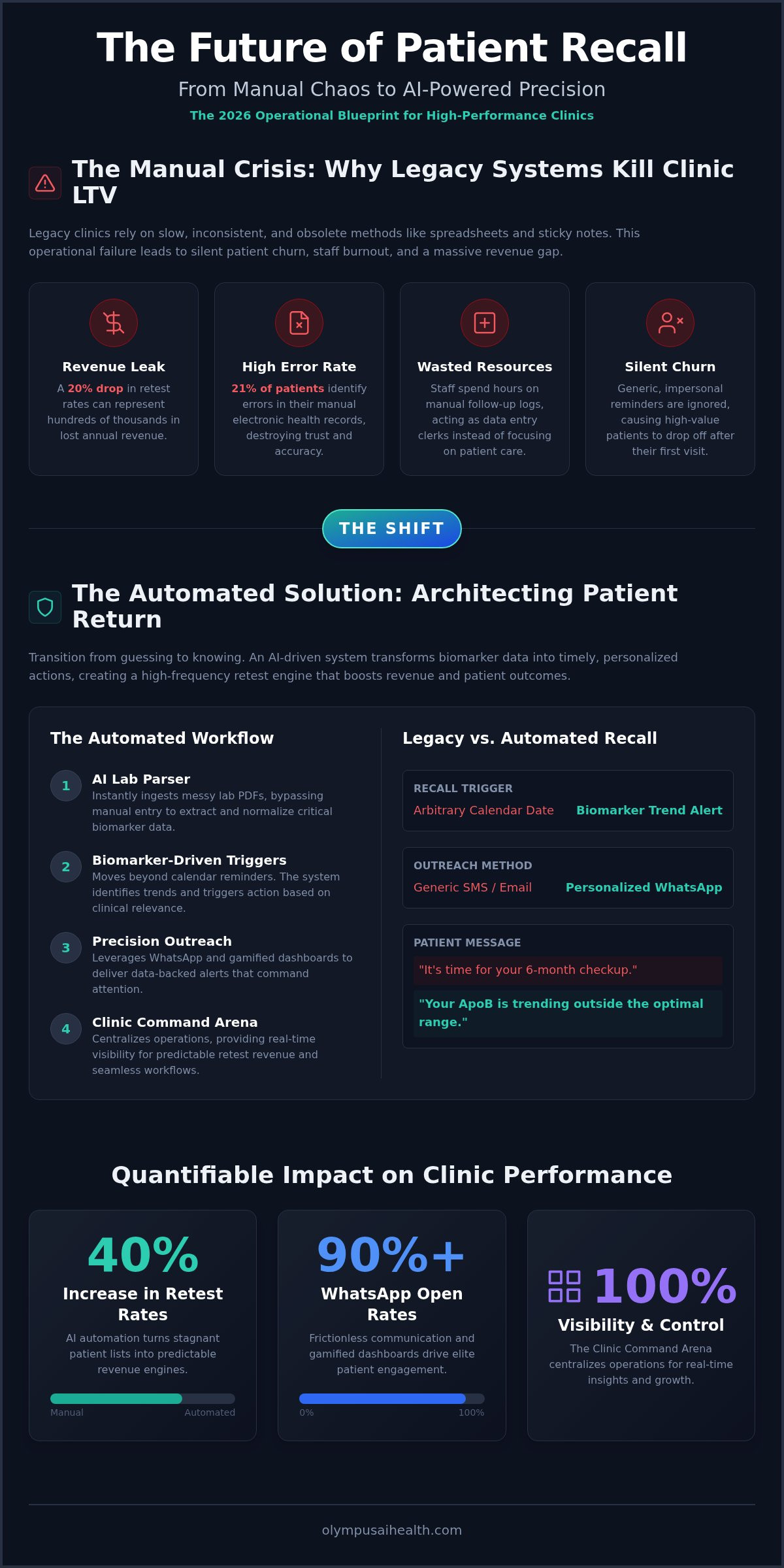
We agree: chasing patients via spreadsheets is a legacy method that belongs in the past. You need a system that thinks faster than your team. Manual systems are slow. They're risky. One study shows 21% of patients find errors in manual visit notes. Discover how to transform stagnant lists into high-frequency retest engines using biomarker-driven automation and gamified engagement. You'll gain predictable retest revenue and seamless clinical workflows.
We'll break down the shift from manual data entry to AI-driven insights // 2026. We're showing you how to leverage the Clinic Command Arena and gamified dashboards to maximize patient lifetime value. The slow, manual past is over. The automated future is here. The command center is ready.
Key Takeaways
- Eliminate the silent churn. Learn why legacy outreach fails high-net-worth patients and how to stop the drop-off after the first consultation.
- Precision logic. Deploy an automated patient recall system for clinics to replace generic calendar reminders with biomarker-aware triggers.
- Architectural speed. Use the AI Lab Parser to bypass manual entry and identify the exact moment a patient is due for their next intervention.
- Frictionless adherence. Leverage the WhatsApp Integration Module and gamified dashboards to maintain 90%+ open rates and elite engagement.
- Command and control. Centralize your operations in the Clinic Command Arena for real-time visibility and predictable retest revenue.
The Manual Recall Crisis: Why Legacy Systems Kill Clinic LTV
Silent churn is the quiet killer of high-end functional medicine. It's the gap between a successful first consultation and the follow-up that never happens. When patients drop off, your Lifetime Value (LTV) craters. This isn't a marketing problem. It's an operational failure. Legacy clinics rely on manual outreach. They use spreadsheets. They use sticky notes. These methods are slow; they're inconsistent; they're obsolete. High-net-worth patients expect a premium experience. They don't want generic SMS reminders that look like spam. They want precision.
Staff burnout is the hidden tax on your growth. When your team spends hours on manual follow-up logs, they aren't focused on care. They're acting as data entry clerks. This inefficiency leads to errors. It leads to missed opportunities. An automated patient recall system for clinics in the 2026 landscape isn't a luxury. It's the command center for your entire operation. It's the difference between a stagnant list and a high-frequency revenue engine.
The Failure of Traditional EHR Reminders
Legacy EHR systems are static. They lack clinical intelligence. They send reminders based on a calendar, not a patient's biological needs. This creates the "ignore factor." Patients see an impersonal template and hit delete. Your brand's prestige is damaged by these low-tier interactions. Furthermore, data silos prevent your recall system from seeing lab results. If your outreach doesn't reflect the patient's specific health journey, it fails to drive patient participation. Effective recall requires context. It requires a system that understands biomarker trends and triggers action at the exact moment of clinical relevance.
Quantifying the Opportunity Gap
The cost of "almost" is staggering. A 20% drop in retest rates can represent hundreds of thousands in lost annual revenue. Manual logs are a liability. Research indicates that 21% of patients identify errors in their electronic records. When your data is messy, your recalls are wrong. You miss the window for intervention. You lose the patient to a competitor who uses better tech. Transitioning to a clinic staff efficiency software model is the only way to scale. You need to automate the mundane to protect the margin. In 2026, clinical excellence is powered by automated logic. Stop chasing patients. Start architecting their return.
Data-Driven Recall: Transforming Biomarker Trends into Automated Action
Calendar-based recall is a guess. It's low-resolution medicine. Legacy systems treat every patient the same, sending out generic "six-month checkup" pings that get buried in the noise. High-performance clinics require an automated patient recall system for clinics built on biological logic, not the Gregorian calendar. When you shift the narrative from "it's time for your appointment" to "your ApoB is trending outside the optimal range," you stop being a vendor. You become a high-level health architect. This is personalization at scale // the new standard for 2026.
The AI Lab Parser is the technical foundation of this transition. It ingests messy lab PDFs, extracts the critical data, and normalizes it within your system. This isn't just data entry. It's the creation of a clinical trigger. By using the AI Insights & Protocol Generator, the system identifies the specific "why" behind the next visit. It justifies the retest by showing the patient exactly where their optimization plan is succeeding and where it's stalling. You're no longer asking for a visit; you're providing a necessary update to their health OS.
Triggering Action via Biomarker Normalization
Normalization is the bedrock of credible outreach. Without it, your data is noise. By connecting your AI biomarker extraction software directly to the recall engine, you create a closed-loop environment. The system monitors the patient's "Longevity Score" in real time. If a critical marker dips, the system triggers a high-priority notification. The patient receives a data-backed alert that feels exclusive and urgent. This isn't spam. It's a precision intervention that protects the patient's health and your clinic's LTV.
Precision Timing: The Science of the Retest
Standard 3, 6, and 12-month intervals are clinically arbitrary. They're a relic of a manual past. AI predicts the optimal retest window based on the half-life of interventions and individual metabolic rates. This reduces outreach fatigue. You only send notifications when they carry high clinical utility. A systematic review on patient recall effectiveness confirms that reminder systems drive compliance, but elite clinics need more than a nudge. They need a system that understands the science of the retest. If you're ready to deploy this level of precision, you can explore the White-Label Longevity OS and start automating your growth.
Case Study: Improving Clinic Retest Rates by 40% with AI Automation
Legacy clinics are bleeding revenue through the cracks of manual management. Consider the baseline of a high-performance longevity clinic we audited. Retest adherence was stagnant at 30%. Despite clinical excellence, 70% of their patients were "one and done." The cause was simple: elite patients were being managed with low-tier tools. By deploying a comprehensive automated patient recall system for clinics, specifically the White-Label Longevity OS, the clinic transformed its operational architecture. The result was immediate. Within the first 90 days, retest bookings surged by 42%. Revenue stabilized. Patient outcomes improved.
This wasn't just a change in software. It was a psychological pivot. When you move from manual pings to data-backed triggers, the patient experience shifts. They no longer feel like they're being sold another lab test. Instead, they're tracking progress. They're engaged in a high-stakes game of biological optimization. This shift is supported by research on the comparative effectiveness of reminder procedures, which shows that the medium and the message dictate the conversion rate. The clinic moved from ignored emails to high-impact WhatsApp notifications. The data speaks for itself.
Phase 1: Eliminating the Spreadsheet Bottleneck
Manual logs are a death sentence for scaling. This clinic was drowning in Excel files that didn't talk to each other. By implementing the Functional Medicine Clinic Spreadsheets Alternative, they automated the extraction of 50+ biomarkers per patient instantly. The AI Lab Parser eliminated the friction of data entry. This freed up 15+ hours of staff time every single week. Instead of acting as clerks, the team returned to high-touch care. Efficiency became the new baseline. The "silent churn" stopped because the data was finally visible and actionable.
Phase 2: Gamifying the Follow-Up Experience
Retention is a design problem. The clinic deployed the Gamified Patient Dashboard to turn abstract lab results into visual Health Cards. Patients could finally see their "Optimization Plans" as a roadmap. They weren't just looking at numbers; they were looking at a score they wanted to improve. This visual desire for data updates is what drives the retest. When a patient sees a "yellow" marker on their dashboard, they don't need a sales pitch to book their next blood draw. They want to see it turn "green." The automated patient recall system for clinics simply provides the frictionless path to that update. It's cool efficiency in action.
Strategic Implementation: Building a Frictionless Retention Engine
Implementation is the bridge between clinical vision and operational reality. It requires a hard pivot from passive reminders to active engagement. To build a retention engine that actually converts, you must follow a structured deployment. First, map your clinical protocols to automated triggers. If a patient's Vitamin D is low, the system shouldn't just wait six months. It should trigger a retest window based on the protocol's expected correction time. This is the logic that powers an automated patient recall system for clinics. It's about architecting the journey before the patient even leaves the room.
The WhatsApp Advantage in the UAE Market
Email is a legacy failure. For high-tier patients, it's noise. In markets like the UAE, WhatsApp is the primary layer of communication. Statistics show that text-based recall campaigns achieve open rates near 98%. Contrast this with the single-digit response from traditional mailers or buried emails. By using the WhatsApp Integration Module, you offer frictionless 1-click booking. It maintains clinical authority through precision while utilizing high-speed digital channels. It's elite interaction for elite clients. It feels exclusive because it is personalized.
Next, move your team into the Clinic Command Arena. This is the operational brain of your business. Training staff to use a centralized dashboard ensures oversight without the manual grind. You stop guessing who is due. You start seeing who is overdue in real-time. Finally, audit your messaging. Use conversion data to refine your tone. If your "Optimization Plan" alerts are converting at 40%, but your "Protocol Update" pings are at 10%, you pivot. Data dictates the strategy. The system learns. The clinic grows.
Onboarding for Retention
Retention starts on day one. You must set the expectation for retesting during the initial patient onboarding. Position the portal as the single source of truth for their health data. Ensure every patient leaves their first visit with a digital health card. When they can see their baseline, they develop a psychological need to see the improvement. This is how an automated patient recall system for clinics becomes a part of their lifestyle, not just a clinical requirement. You aren't just a doctor. You're the curator of their biological data.
Build your high-intensity retention engine today. Get started with the Clinic Command Arena.
The Clinic Command Arena: Your OS for Automated Growth
Data without visibility is a liability. While earlier sections detailed the power of biomarker triggers, the Clinic Command Arena is where that data becomes operational power. It aggregates every lab result and protocol insight into a high-intensity dashboard. This is the operational brain of your business. It provides real-time visibility into your entire patient population. You see who is optimized; you see who is due; you see exactly who is overdue. It is the definitive automated patient recall system for clinics that value precision over guesswork.
Scaling a practice usually requires more administrative headcount. Not here. The AI Insights & Protocol Generator identifies revenue opportunities by flagging patients who need adjustments before they even realize it. You're scaling your longevity brand through logic, not labor. The system handles the heavy lifting of tracking. Your team handles the high-level care. It's a lean, high-output model designed for the 2026 clinical landscape. You're no longer limited by the number of hours your staff can spend on the phone.
Operational Excellence for Clinical Staff
Practitioners are drowning in mental load. They're checking logs; they're chasing labs; they're acting as administrators. The Command Arena eliminates this friction. It facilitates rapid decision-making by presenting the most critical data first. You move from reactive management to a proactive health optimization model. You don't wait for the patient to feel "off." You see the data dip and trigger the recall automatically. This is cool efficiency. Your staff stays focused on the patient; the OS stays focused on the data.
Future-Proofing Your Longevity Practice
The market is evolving. You're no longer just a clinic where people go for a checkup. You're a Health Optimization Platform. By white-labeling the Longevity OS, you build long-term brand equity that exists outside of your physical four walls. Your patients carry your brand in their pocket via the Gamified Patient Dashboard. You're providing a premium, exclusive service that legacy competitors cannot match. The shift from a service-based business to a platform-based ecosystem is the only way to survive the next decade. The future is automated logic. Anything else is obsolete.
The command center is ready. The architecture is built. Stop managing spreadsheets and start leading the industry. Your next step is clear. Booking a demo of the Olympus AI Technologies ecosystem is how you deploy your automated patient recall system for clinics and secure your position at the forefront of longevity medicine.
The Architecture of Perpetual Growth // 2026
Legacy clinics are defined by their manual limits. Future-proof clinics are defined by their automated logic. You've seen the data. Manual recall is a revenue leak that kills LTV. Precision medicine requires a precision engine. By integrating AI-driven biomarker extraction and the WhatsApp Integration Module, you transform your practice from a static service into a high-velocity health optimization platform. You stop guessing. You start architecting.
Deploying a sophisticated automated patient recall system for clinics is the only way to scale without adding administrative weight. You gain the Clinic Command Arena. You deploy Gamified Patient Dashboards that drive a psychological desire for retesting. The transition from manual spreadsheets to a white-label Longevity OS isn't just an upgrade; it's a total operational transformation. The silent churn ends here. Your predictable revenue begins now.
The command center is ready for deployment. Stop chasing one-off consultations and start building a high-frequency retest engine that runs on autopilot. You have the vision. We have the architecture. It's time to lead the industry.
Secure Your Clinic Command Arena // Book a Demo
Frequently Asked Questions
What is an automated patient recall system for clinics?
An automated patient recall system for clinics is a high-performance operational engine that triggers retest notifications based on biomarker logic rather than arbitrary calendar dates. It replaces manual outreach with precision-timed alerts. This system ensures that patients return exactly when their biological data suggests an update is necessary. It's the end of guessing and the start of data-driven retention architecture.
How does AI improve clinic retest rate improvement?
AI identifies revenue opportunities by analyzing lab PDF data to predict the optimal retest window for each patient. It moves beyond generic reminders. By calculating the half-life of specific interventions, the AI ensures your outreach carries high clinical utility. This level of precision increases retest adherence by turning every follow-up into a necessary data update for the patient's optimization plan.
Can automated recall systems integrate with existing EHRs?
Integration is a core feature of a modern automated patient recall system for clinics. These platforms utilize advanced standards like HL7 FHIR to sync seamlessly with legacy EHRs and practice management software. This creates a unified command center. Your data flows from the clinical record into the recall engine without manual intervention. It's a frictionless bridge between your existing records and future growth.
Is WhatsApp better than email for patient retest reminders?
WhatsApp is the dominant channel for elite patient engagement in 2026. While email open rates continue to crater, WhatsApp delivers near 98% visibility. It provides a direct, high-speed connection to your patients. The WhatsApp Integration Module allows for 1-click booking. It's a premium, frictionless experience that matches the expectations of high-net-worth individuals who demand efficiency over traditional, slow-moving communication.
How do gamified dashboards increase patient retention?
Gamified dashboards transform abstract lab results into visual Health Cards that patients actually want to update. This creates a psychological level-up effect. When a patient sees their biological markers as a score to be optimized, the retest becomes a goal. It's no longer a clinical chore. It's an essential step in their personal optimization journey, leading to significantly higher long-term adherence.
Is an automated recall system compliant with UAE data regulations?
Compliance is non-negotiable. Modern recall systems are built to meet the Minimum Necessary Standard for patient communications under HIPAA and local UAE data residency laws. They ensure that only the essential data is used to trigger reminders. Patients must provide consent via TCPA-compliant opt-ins. This gives you a high-intensity engagement tool that remains fully protected and legally sound in the 2026 regulatory environment.
How much staff time can be saved with an AI lab report parser?
The AI Lab Parser can save your clinic over 15 hours of manual labor per week. It eliminates the hidden tax of data entry by instantly extracting over 50 biomarkers from messy lab PDFs. This allows your team to stop acting as data clerks. They return to high-level clinical work. You scale your operations without increasing your administrative headcount. It's pure operational efficiency.
What is the typical ROI of implementing a longevity operating system?
ROI is realized through the elimination of silent churn. Most longevity clinics lose up to 70% of patients after the first visit. By deploying a White-Label Longevity OS, you recover that lost revenue. You move from a 30% retest rate to a predictable, high-frequency model. The result is a massive increase in patient lifetime value (LTV) and a stabilized, scalable revenue engine for your brand.